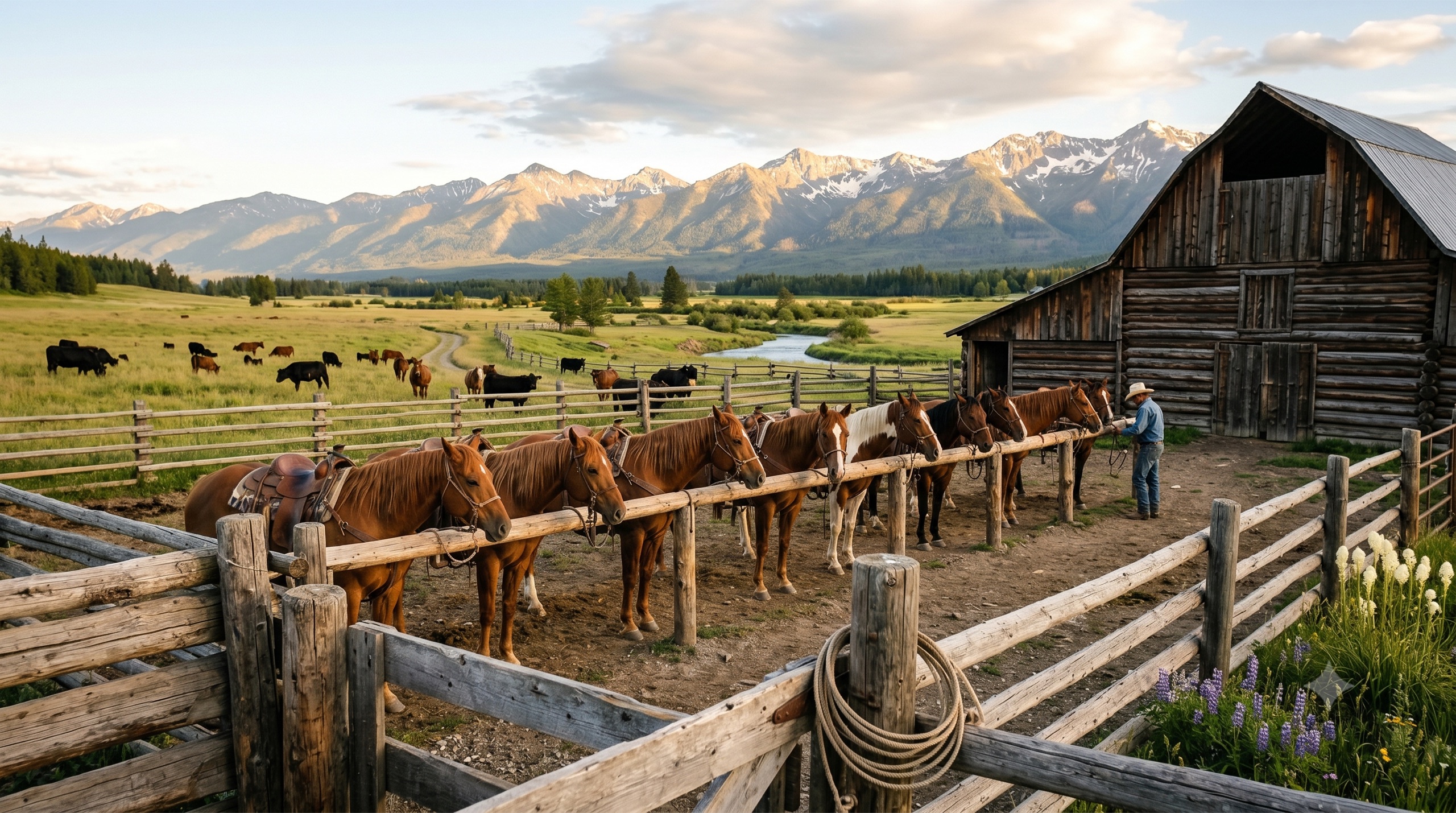
Beargrass Ranch sits on about seven thousand acres of the Flathead Valley, laid out between the Flathead River on the low side and the Whitefish Range climbing up on the high side. You come in off Beargrass Road, past the cattle guard, and the country opens up in front of you — hay meadows running flat and green toward the timber, fence lines you could follow for an hour, and behind it all the mountains, holding snow into June. It is a big piece of ground, and on a clear morning you can stand at the corrals and see most of it.
The land does the work of telling you what season it is. There are stands of larch and lodgepole on the benches, dark green most of the year, and then every October the larch turns a gold so bright it looks lit from inside before it drops its needles and goes bare for winter. There are black Angus on the grass, a working string of horses in the home pasture, and irrigation ditches that have run the same lines since before any of us were born. We grow our own hay here, and we put it up ourselves, and the smell of a cut meadow in July is one of the best things I know.
And then there is the beargrass. Up on the high meadows, for a few weeks in July, the beargrass blooms — tall white plumes standing up out of the grass by the thousands, the same flower you'll see in Glacier's high country. It is where the ranch got its name. Walter Calloway found this ground in the spring and bought it in the summer, and the story in our family is that the beargrass was up when he signed the papers, and that settled the name before there was anything to put it on.
Walter and Ada Calloway started the ranch in 1947. They came out of the war years looking for ground to run cattle on, found this valley, and never left. They built the first barn, ran the first small herd, raised their family in a house that is still standing, and learned the hard arithmetic of making a living off mountain country — long winters, short summers, and weather that does not care about your plans. Most of what we know about running this place, we know because they figured it out first.
Their son, everyone called him Bud, grew up on the ranch and took it over when it was his turn. Bud is the one who first opened the gate to guests. In the 1970s he built a handful of cabins down by the creek, mostly because people kept asking if they could stay, and because he thought a real working ranch was worth sharing with folks who would never otherwise see one. He was right, and those first cabins are the reason there is a "stay" page on this website at all.
Today my brother Wade and I run the place — the fourth generation. Wade handles the cattle and the day-to-day of the operation; he is the one out before light in calving season and the last one in during haying. I look after the rest of it: the guests, the lodge, the table, the books, and the hundred small things that keep a ranch standing. Our kids are underfoot and learning the work, the same as we did, the same as Bud did. We are not the first Calloways on this ground and we do not intend to be the last.
Before Beargrass Ranch is anything else, it is a working cattle and horse outfit, and it runs on the calendar that work keeps. We do not slow the ranch down for the season or dress it up for company. What you see when you visit is what is actually happening that week, because that is the only ranch we have to show you.
The year starts in the cold. Calving comes in late winter and early spring, and it is the hardest stretch we have — checking the herd around the clock, pulling a calf when it needs pulling, getting the new ones up and nursing before the weather turns on them. By late spring the grass is coming, the cattle move to summer pasture, and the long days begin. Summer is haying — cutting, raking, and baling the meadows while the weather holds, then doing it again. There is fence to fix every month of the year, horses to keep shod and working, and water to move across the place.
Come fall, we gather and move the cattle down off the high ground, sort and ship, and the outfit shifts into the hunt — guided hunts run from September into November, when the high country is gold and then white. Winter is quiet but never idle; the herd still has to be fed every single day, and we spend the cold months fixing what broke, planning what's next, and waiting on the beargrass to come up again. It is a full circle, and it has not stopped turning since 1947.
We could run this place without ever letting a stranger past the cattle guard. Plenty of ranches do. But Bud believed that a real working ranch was worth sharing, and we believe it still — so from May through October we open the gate and make room for guests, and the outfit runs into the fall hunt besides.
What we are not is a theme park. There is no staged cattle drive that ends in time for cocktails, no "cowboy experience" with the cowboy added on for the occasion. The wranglers who take you out are the same ones who work the herd. The horse under you is a ranch horse with a job. The beef on your plate at the cookhouse supper was raised on the grass you can see from the table. When you stay here, you are a guest on a ranch that would be doing exactly this whether you came or not — and we think that is the whole point. The difference between watching the West and being in it, for a few days, is the gate we leave open.
That is also how we keep the ranch a ranch. Opening the gate lets us hold onto this ground and this way of doing things, and pass it on whole to the kids who are out there right now learning to ride. So if you come, come ready to be on a real place. Ask questions. Get up early. Get a little dust on you. We would rather you leave knowing what a working ranch actually is than send you home with a souvenir.
The ranch sits in one of the finest corners of the Northern Rockies. We are off U.S. Highway 2 between Columbia Falls and Hungry Horse, in the Flathead Valley — close to town when you want it, but far enough out that the only sounds at night are the creek and the cattle. The valley is broad and green, ringed by mountains on nearly every side, and it has been drawing people who love wild country for a long time.
Best of all, Glacier National Park's west gate is just a short drive up the highway. One of the great wild places left in the lower forty-eight is practically our back fence — its high meadows carry the same beargrass that grows on ours, and a day in the park is an easy thing to add to a stay here. We can saddle horses for a ride into the high country, send you off to fish the Flathead, or simply point you up the road toward the mountains and tell you when to be back for supper.
Between the river, the range, the park, and the work of the ranch itself, there is more here than you can do in one visit. That suits us fine. Come see the country, eat at our table, stay in a cabin Bud might have built, and find out what four generations have known all along — that this is a place worth coming back to.